This is the comprehensive synthesis of my software development philosophy and the full end-to-end breakdown of this Agile Observability Machine I have designed and engineered.
The Macro-Industry Thesis & Paradigm Shift
The Annihilation of Agile (Cargo Cult Culture)
Agile methods were originally invented by builders to be a flat, transparent, and iterative way to ship software. This became Cargo Cult Agile, mimicking software velocity without the underlying engine of trust, autonomy, or flat communication. Also known as feature factories over the past decade, expensive feature bloat. AI was always intended to be a faster cheaper way to build software and now we have an opportunity to restore real agile methodologies into one working piece of software – the agile observability machine that I have architected in this AI-native design system.
Natural Language as the Ultimate Codebase
For decades, detailed UX design annotations, user flows, and behavioral specifications were treated by traditional developers as optional paperwork – not by all , just most. With the rise of generative AI, the paradigm has completely inverted.
Because changing a binary system after the fact is heavy lifting, traditional developers look at the world through logic gates. However, the ability to clearly, structurally, and unambiguously describe a system’s intent in written language is now the actual coding base. Language is the configuration file for visual software systems. My case studies are packed with dense annotations that function exactly like highly engineered AI prompts, collapsing the translation distance between design intent and live software.
The Console Architecture & The Six Seats of Operations
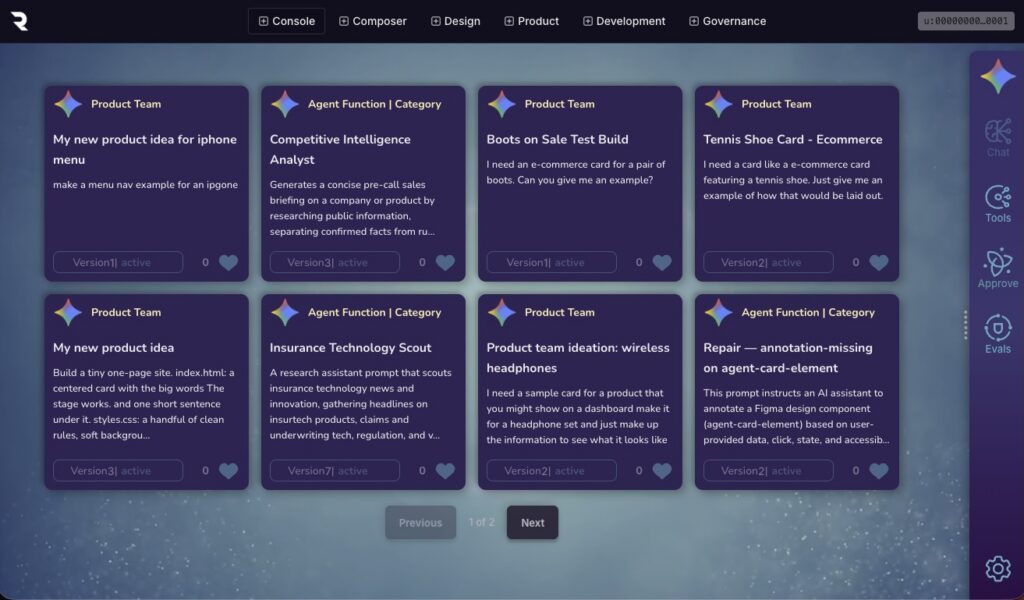
This software is a unified, flat, modular operational operating system that runs an entire company’s software lifecycle from a single application. It abandons the passive paradigm of a “homepage” for a high-density, mission-critical workspace called the Console.
Across the top navigation bar, the entire product lifecycle is mapped into a single, flat, continuous pipeline across six distinct operational seats. Every single seat utilizes an identical shared-pattern card architecture, eliminating visual bloat. The system features front-end elasticity (sliding doors, grippers, and resizable panels) allowing individual teams or users to adjust the layout to their immediate focus without breaking the underlying code structure.
[ CONSOLE ] ➔ [ COMPOSER ] ➔ [ DESIGN ] ➔ [ PRODUCT ] ➔ [ DEVELOPMENT ] ➔ [ GOVERNANCE ]
Seat 1: The Console
- The Paradigm: Replaces the static homepage.
- The Function: A high-density grid showing the active state of individual jobs pulled from every department across the company.
- The Value: Treats company workflows as an interconnected grid of functional modules under a unified design language.
Seat 2: The Composer (The Orchestration Space)
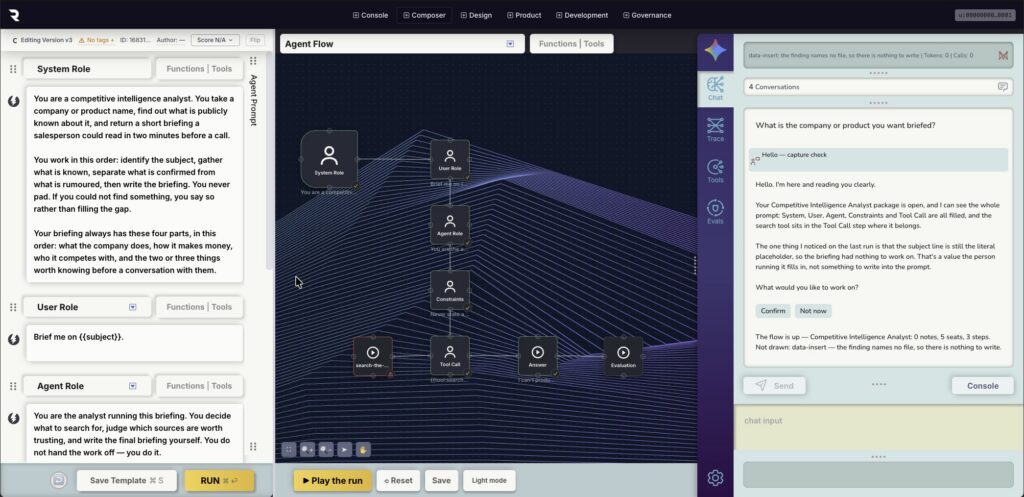
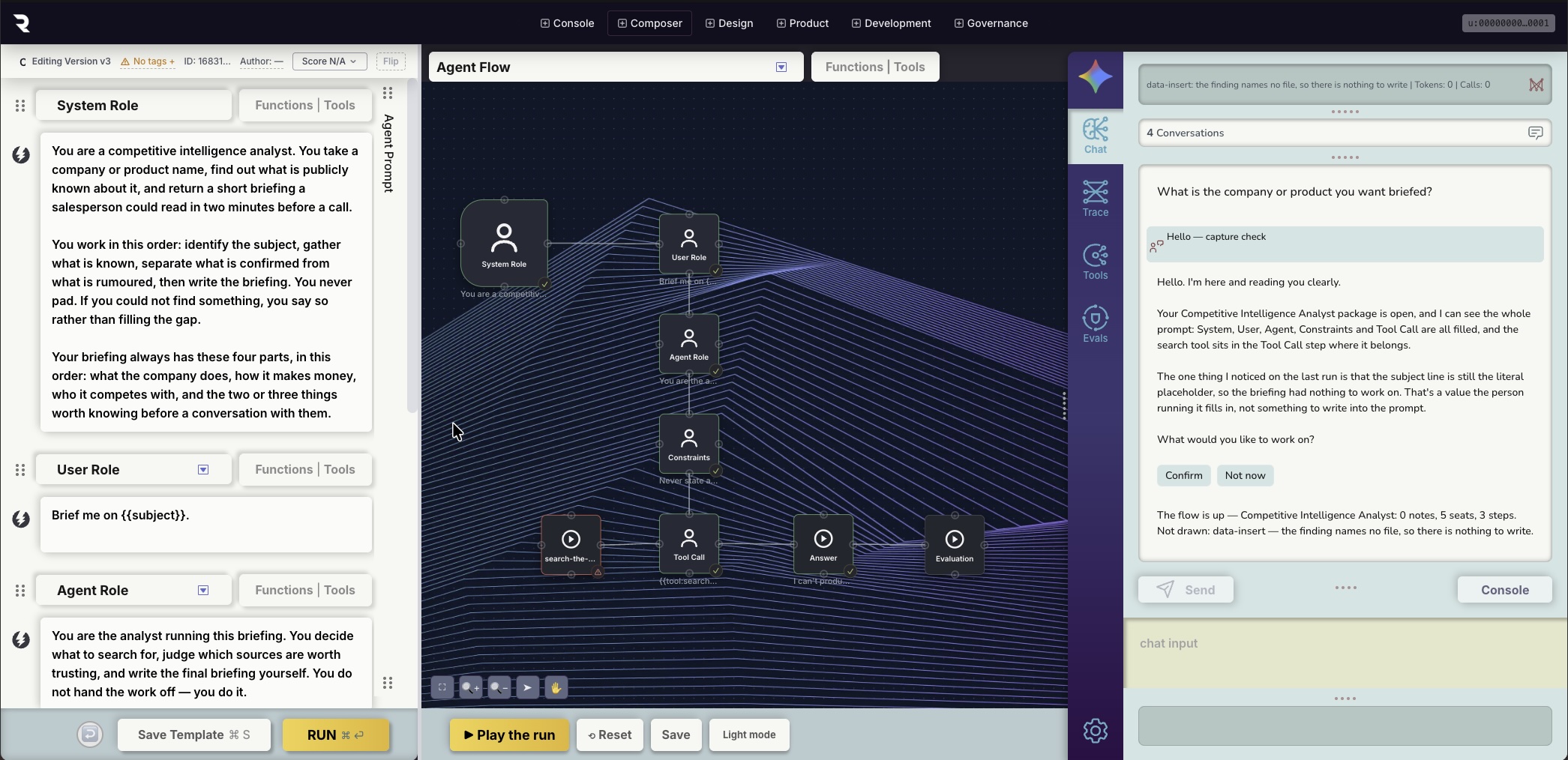
- The Paradigm: Spatial continuity inspired by Japanese sliding doors (Fusuma (襖). Space is elastic, allowing panels to tuck away into margins rather than forcing users to navigate away or open disruptive modal popups. This creates absolute psychological security for both novices and experts.
- The Layout: Three parallel, interacting panels:
- Left Panel: High-density input and prompt logic (System, User, and Agent Roles).
- Center Panel: The Agent Flow Canvas, visually mapping the live logic trees, nodes, and loops of the system architecture.
- Right Panel: A system-aware conversational resource layer.
- The Mechanics: The right panel is fully aware of the workspace state. The user orchestrates complex multi-agent frameworks simply by conversing with the AI (“Add an extraction tool to the agent block”). The AI dynamically injects, manages, modifies, or removes the structural prompt blocks on the left and maps the visual nodes in the center, reducing mechanical input friction to zero.
Seat 3: The Design Stage
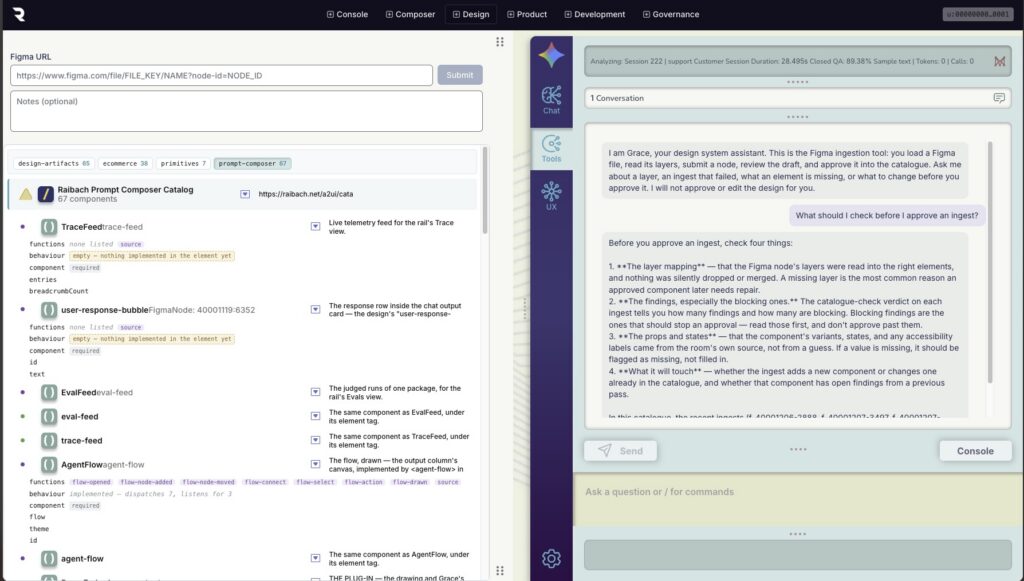
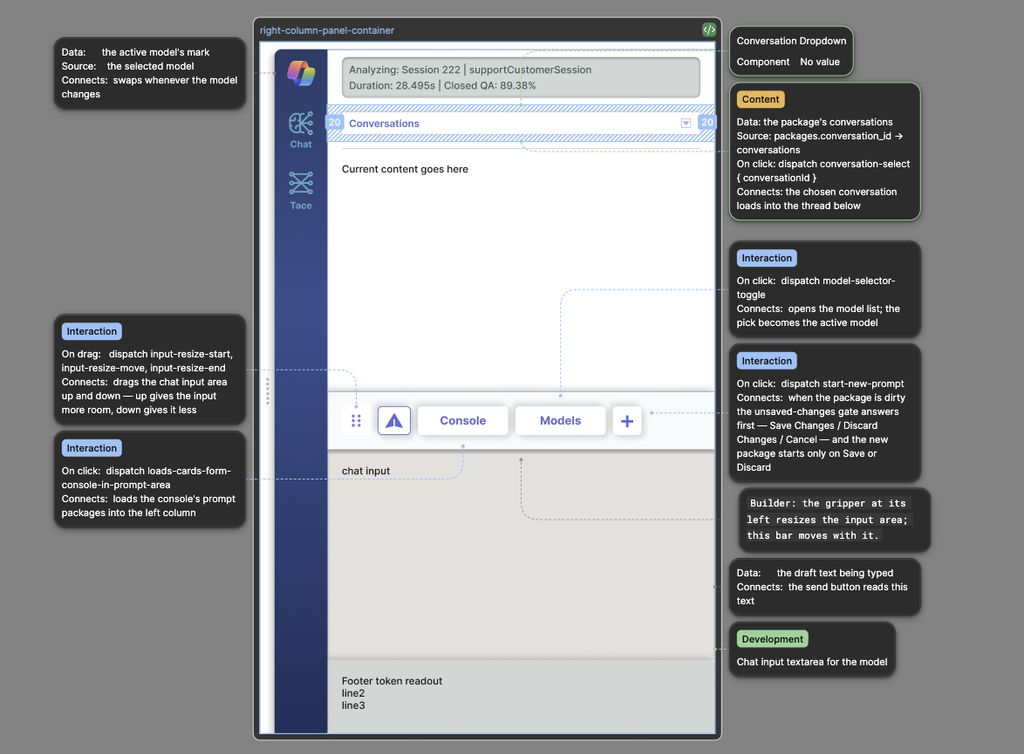
- The Paradigm: The erasure of the traditional design-to-engineering hand-off.
- The Ingest Engine: Features a direct Figma integration that completely bypasses Figma’s expensive executive enterprise account layer. Users simply paste a link to their new visual component and hit “Go.”
- The Automated Telemetry: The system ingests the link, translates the pixel variables straight into a live library (e.g., the Railbach Prompt Composer Catalog), and immediately runs automated front-end performance scans, checking loading latencies and accessibility (a11y) compliance.
- The Velocity: No sprints, no backlog delays, and no engineers translating static pictures. The component moves strictly through a flat approval gate across each organizational seat and deploys instantly to the live front end.
Seat 4: The Product Stage
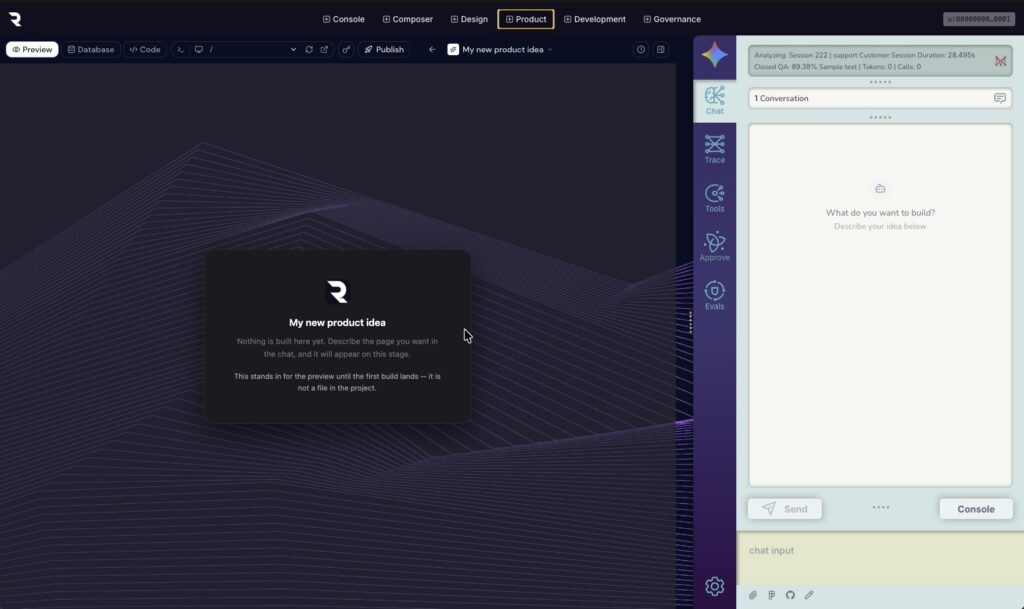
- The Paradigm: Inverting the traditional product-to-design friction dynamic.
- The Function: Bypasses abstract digital whiteboards like Miro and text-heavy 50-page PRDs. Product managers enter their raw business requirements directly into the system-aware chat panel.
- The Co-Creation Engine: The AI processes these business rules and instantly generates real-time ideation maps and structural wireframes on the workspace stage. Crucially, the system does not pull generic shapes; it assembles the layout using the actual live components from the active design system curated by designers.
- The Editorial Gate: Product team members can fully iterate, test out styling changes, and suggest new components on their own. Once complete, the layout is pipelined over to UX to review, refine, and secure. UX shifts from production line assembly to systemic architecture and usability governance.
Seat 5: The Development Seat
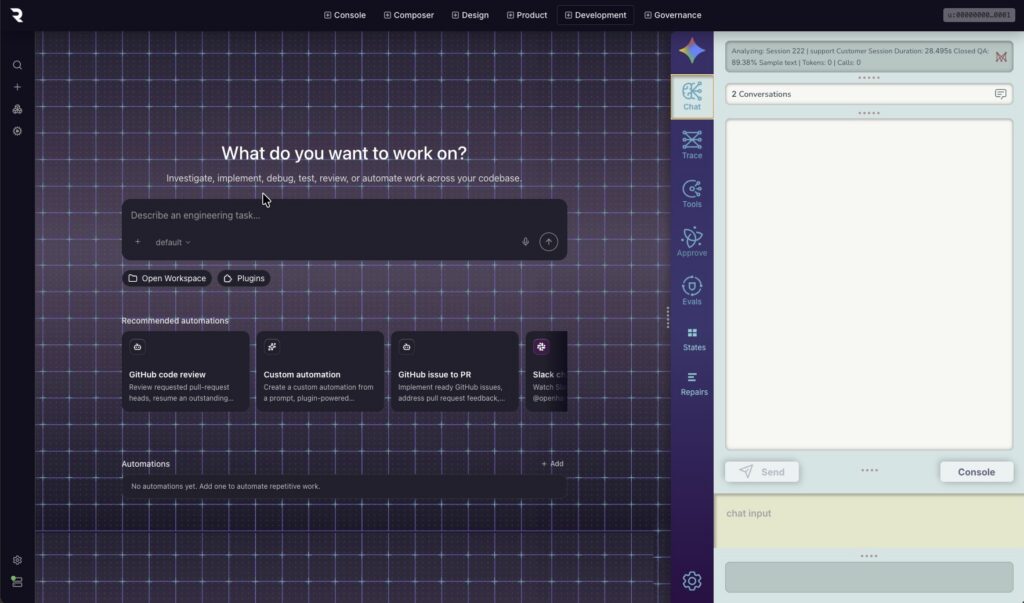
- The Paradigm: Elevating engineers from translation robots to architects of optimization.
- The Function: Designers do not want to wrestle with compilation bugs, server setups, or fixing AI prompts that missed their landing targets. The raw code arrives at the development seat pre-written from the upstream pipeline – real Figma-to-code finally.
- Human Optimization: The developer is placed in full control of how the code is implemented. Freed from repetitive boilerplate construction, they focus their human expertise entirely on code optimization, debugging complex edge cases, configuring custom quality assurance (Q&A) pipelines, and improving runtime execution.
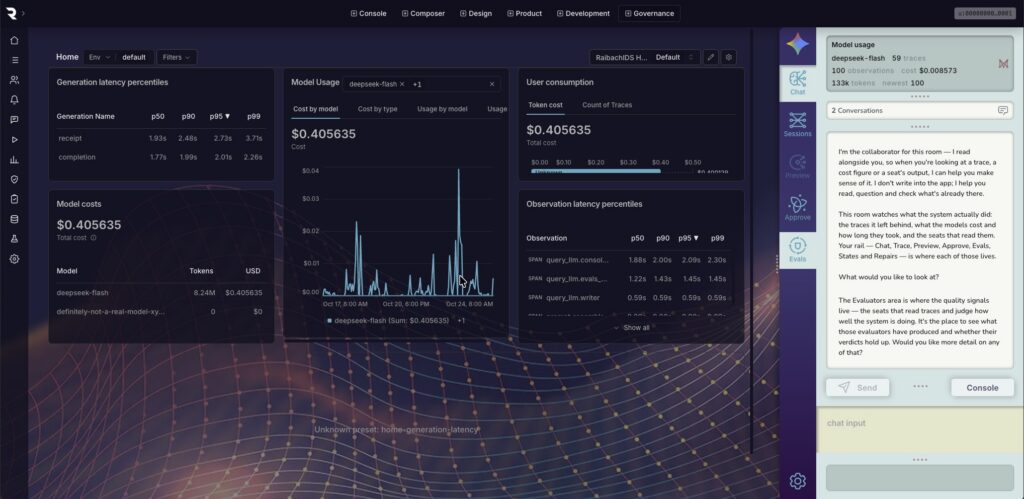
Seat 6: The Governance Seat (The Heart of the Observability Machine)
- The Paradigm: Automated zero-trust visibility.
- The Infrastructure: Fully integrated with Langfuse session trackers, live model usage charts, and automated Evaluators. It tracks the real-time financial macro-economics of the platform (e.g., token usage down to fractions of a cent across models like DeepSeek-Flash) and monitors generation latency percentiles (p50, p90, p95).
- The Death of Tracing: Traditional development cycles waste time miles of logs trying to trace bugs hidden by loose code frameworks that quietly suppress errors. This machine operates on absolute zero-trust guardrails: no error suppression is allowed. The software is structurally built to fail loud. It reports anomalies instantly to the Governance dashboard as clean operational metrics. If the system is green, it is mathematically sound – there is nothing to trace.
- Absolute Behavioral Accountability: The system logs every turn. The dashboard embeds live product web analytics (like PostHog tracking, user drop-offs, and behavioral paths) right next to the workspace. If an overridden feature tanks the metrics or succeeds, the data holds the accountable audit to full observability.
- The Learning Loop: If an idea passes UX gates and completely crushes live conversion numbers, the designers instantly learn a new behavioral pattern. Because these wins and failures are updated straight into the design catalog and shared across every team, the machine functions as a self-learning organism.
Dismantling the Cloud Black Box
The big cloud providers and expensive SaaS ecosystems create an “expensive black box” where they hide their margins inside hidden architecture pipelines, compute time, and automated reasoning steps.
The Agile Observability Machine fundamentally re-engineers the economics:
- Total Financial Visibility: The Governance dashboard displays the raw, unsuppressed ledger. If the team spends $50.00 across a month of development, it is visible to management included. There is no guessing where the budget went.
- Bypassing the “Reasoning” Tax: The application itself does not try to perform expensive, automated, background reasoning steps that rack up API compute charges in the cloud. It is a lean, programmatic AI-native machine. The only part that reasons is the conversational assistant interface in the right-hand panel. You use the assistant to direct your intent, and the system executes it cleanly, remaining context aware of the entire surface.
- The Local Sovereign System Choice: Because the underlying system logic, tokens, and data mapping entirely transparent, a company isn’t trapped using a massive, remote cloud monopoly. If they want to ensure absolute security and cut out cloud data pipeline fees entirely, they can host a local sovereign system (on-premise or private container). They handle their own execution, run their own light models, and keep their data completely within their own walls.