
To establish the foundation of Southern California Edison’s (SCE) enterprise prompt portal personas, I focused on understanding diverse role-based mental models, moving beyond generic descriptions to specific operational realities; enabling targeted strategies and solutions aligned with SCE’s workforce enablement initiative.
Project: AI Enterprise Prompt Portal for Southern California Edison
Client: Southern California Edison (I was an embedded Lead UX Designer for Logic20/20)
Timeline: November 2025 – February 2026
Role: Lead UX Designer – UX strategy, research, prototyping, validation
Team: Project Manger and Business Analysts (BA) worked together with UX during discovery to conduct interviews and synthesize findings.
Tools: Figma, interviews, modular design libraries
Our development process incorporates:
| Technical Skills: Identifying core technical competencies and specialized knowledge to tailor learning content and tools. Expected Outcomes: Defining primary goals and successful results to align training and resources. Pain Points: Uncovering frustrations and inefficiencies (e.g., technical glitches, resource gaps) to design effective solutions. Key Activities: Outlining essential tasks and workflows to understand job functions. |
User Stories: Crafting narratives like “As a [persona], I want to [action], so that [benefit]” (e.g., a Field Engineer quickly accessing schematics) to concretely illustrate needs. Job Titles & Metrics: Using job titles as a starting point, augmented with tenure, department, and experience for deeper persona insights. Learning & Success: Analyzing learning preferences, prompting needs, and success definitions to inform training and support systems. |
Discoverability Challenge
Shared Pain Point: Enterprise prompt libraries face three key challenges. First, discoverability suffers from poor tagging systems, absent semantic search capabilities, and overwhelming prompt volumes that make finding relevant content difficult. Second, trust and compliance concerns are important in regulated utilities where AI outputs must be auditable and accurate to meet strict requirements. Third, workflow integration remains essential, as prompts must operate within existing enterprise systems without disrupting established processes, following the model of platforms that embed AI directly into daily tools.

Project Assets Provided by SCE
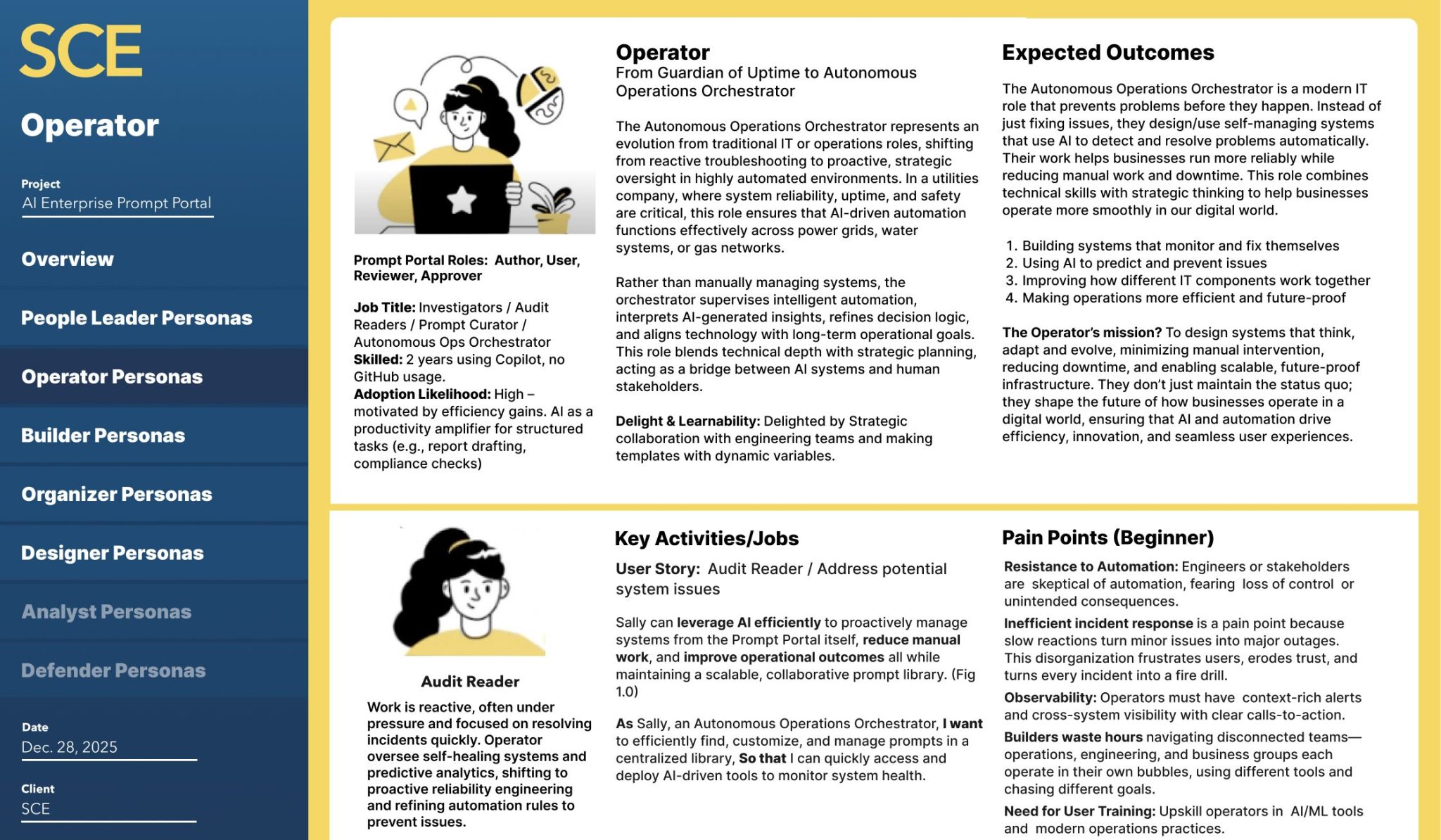
SCE already had personas done by a previous group for workplace development, however we needed to focus these roles on how they use the prompt portal. The work they do daily only influences the content loaded when the role logs in. The actual user flows are very similar.
 |
 |
Organizer Example: From Task Juggler to Al-Augmented Navigator
| The following are examples of how I expanded these personas to address pain points to incorporate user flows for the prompt portal. Organizer can save time, reduce manual effort, and improve stakeholder alignment by automating the creation of tailored, actionable updates. It transforms a traditionally time-consuming task into a scalable, data-driven process that enhances communication and decision-making. Organizer use predictive dashboards and automated reporting to organize strategy and manage risks. | Prompting needs The Organizer (e.g., a program manager, operations lead, or team coordinator) uses a prompt library to shift from manual, reactive task management to AI-augmented navigation and agentic workflows, freeing them to focus on strategy and execution.Delight & Learnability: Delighted by Strategic collaboration. Learnability enhanced through portal suggestions based on my recent usage and peer sharing/feedback, and prompt templates. |
Here are few of the more fully-unpacked personas focused on the software we are building.


Converting Generic Roles to Prompt Portal Personas
Core Complexity Issues – Dual-Axis User Segmentation Problem
Challenge: Every role exists on two dimensions simultaneously (role type + proficiency level), creating exponential persona combinations. A “Program Manager – Novice” has vastly different needs than “Program Manager – Advanced,” yet both need the same core tool. Risk: Over-segmentation (too many personas) vs. over-generalization (losing critical distinctions).
Governance Role Ambiguity
Advanced users must perform fundamentally different tasks (oversight, approval, governance) that aren’t just “more complex” versions of basic prompting. Advanced personas need separate workflows for Prompt validation and approval; Quality assurance and bias detection; Compliance verification; Template governance and versioning. Risk: Conflating “power user” with “governance user” when these require different mental models.
Trust Calibration and Workflow Integration
| Trust calibration presents a core design challenge because different users need different trust mechanisms. Novice users seek simple indicators confirming an output is safe to use. Advanced users need transparency into underlying assumptions to assess applicability and reliability. Governance users require complete auditability with full provenance chains documenting modifications, approvals, and usage. The interface must balance the simplicity novices need with the transparency experts require, while providing governance users comprehensive audit trails.This creates a significant design tension: the interface must balance the simplicity novices need to build confidence with the transparency experts require to exercise appropriate skepticism, all while providing governance users the comprehensive audit trails necessary for regulatory compliance. | Workflow integration depth compounds this complexity, as each proficiency level requires different degrees of system connectivity. A novice Field Engineer simply wants a one-click “Generate Safety Checklist” button that works immediately without configuration. An advanced Operations Lead needs that same functionality to seamlessly auto-populate CRM fields via API integration, eliminating manual data transfer. The fundamental risk here is architectural: organizations must decide whether to build three separate systems tailored to each need or create one flexible architecture that can accommodate all three use cases without overwhelming any single user group. |
Outcomes:
Single interface must serve contradictory needs (speed vs. control, simplicity vs. customization)
Field Engineer (Novice): Success = “Found working prompt in <2 minutes”
Compliance Officer (Advanced): Success = “Identified and flagged 3 non-compliant prompts this week”
Program Manager (Advanced): Success = “Reduced report generation time by 60% while maintaining approval workflows”
View all personas and experience the deliverables file handed off to SCE stakeholders fro final review.


