

The Crystal That Learned to Bob and Weave
A crystal just did something no one thought a solid could do, and it might be a preview of the future of AI hardware.
For four centuries, crystallography has rested on one assumption: solids are boring. Atoms find a repeating lattice and stay there; order means periodicity and predictability. It’s why we can predict a crystal’s properties from its unit cell and call it a day.
Quasicrystals broke the first half of that assumption in 1982: order without repetition, Penrose tiling made atomic, a discovery so unwelcome that Linus Pauling spent years insisting Dan Shechtman was wrong before the Nobel committee decided otherwise. Fundamentally, even quasicrystals were still deterministic arrangements. If you dig crystals then checkout the 20 sided crystals found in space: https://www.pbs.org/brand-new-quasicrystal-discovered-meteorite
Researchers at Nankai University, publishing in Light: Science & Applications (Aug. 2026), cooled a ferroelectric crystal called KTN:Li through its phase transition and watched its internal dipoles do something unprecedented. Instead of settling into the simple aligned domains every ferroelectric material forms, the dipoles wove: strands passing over and under each other in three dimensions, like a textile assembling itself out of charge. No one had previously reported this kind of spontaneously woven three-dimensional domain structure in a bulk ferroelectric crystal.
It gets stranger.
Point a focused green laser at part of the weave and you can untangle it, locally, surgically, without touching the rest of the crystal or destroying the structure. You can rewrite the fabric and the pattern that results is topologically protected: stable against thermal noise and vibration because of its shape, not because someone spent a fortune cooling it to millikelvins in a dilution refrigerator. It forms and remains stable near room temperature.
That combination—3D, self-organizing, laser-addressable and stable near room temperature, is what’s got people outside condensed matter physics paying attention.
What follows is what it implies, and implication is not proof.
A new twist on AI hardware
AI hardware has a bottleneck baked into its bones. Von Neumann architecture separates memory from computation, so every operation means shuttling data back and forth across a physical gap, and that shuttling is where much of the power and latency goes. Not the math: the commute.
Two different materials technologies are being discussed here, and they should not be confused. The first is the newly reported KTN:Li ferroelectric crystal, in which researchers observed a three-dimensional, self-organizing woven network of polarization domains that can be locally altered with focused light. That crystal has not been demonstrated as a memristor or as a computing device; what it provides is an unusual, optically addressable form of physical memory and three-dimensional domain organization.
The second line of research involves memristive and resistive-memory hardware. Researchers have already demonstrated devices that retain state while participating directly in computation, including memristor arrays whose intrinsic switching randomness can be exploited rather than eliminated. In stochastic and probabilistic computing, that physical randomness can become part of the calculation itself. The significance is therefore not that the KTN:Li crystal has already become a stochastic computer. It is that two previously separate research directions – three-dimensional, reconfigurable ferroelectric structures and local, stochastic memristive computation, which suggests an intriguing architectural possibility. A future material or device architecture might combine persistent physical state, computation, useful randomness, and optical addressing within the same substrate.
That’s the hypothesis that lays out the exact technical blueprint that makes NVIDIA’s entire GPU computing monopoly obsolete. What exists is a material behaving in a way that makes the hypothesis newly specific instead of abstractly aspirational, and in materials science, that gap between “specific” and “abstract” is usually where the real work starts or the real disappointment sets in. We won’t know which for years.
The entire history of computing has been software straining against dumb, rigid material substrates, begging silicon to simulate intelligence it was never shaped to hold. This is the first serious hint of the inverse move. Not smarter code running on inert material, but material that already has the right shape, waiting for light to tell it what to become.
We spent forty years teaching silicon to think. This might be the first crystal that started weaving on its own.
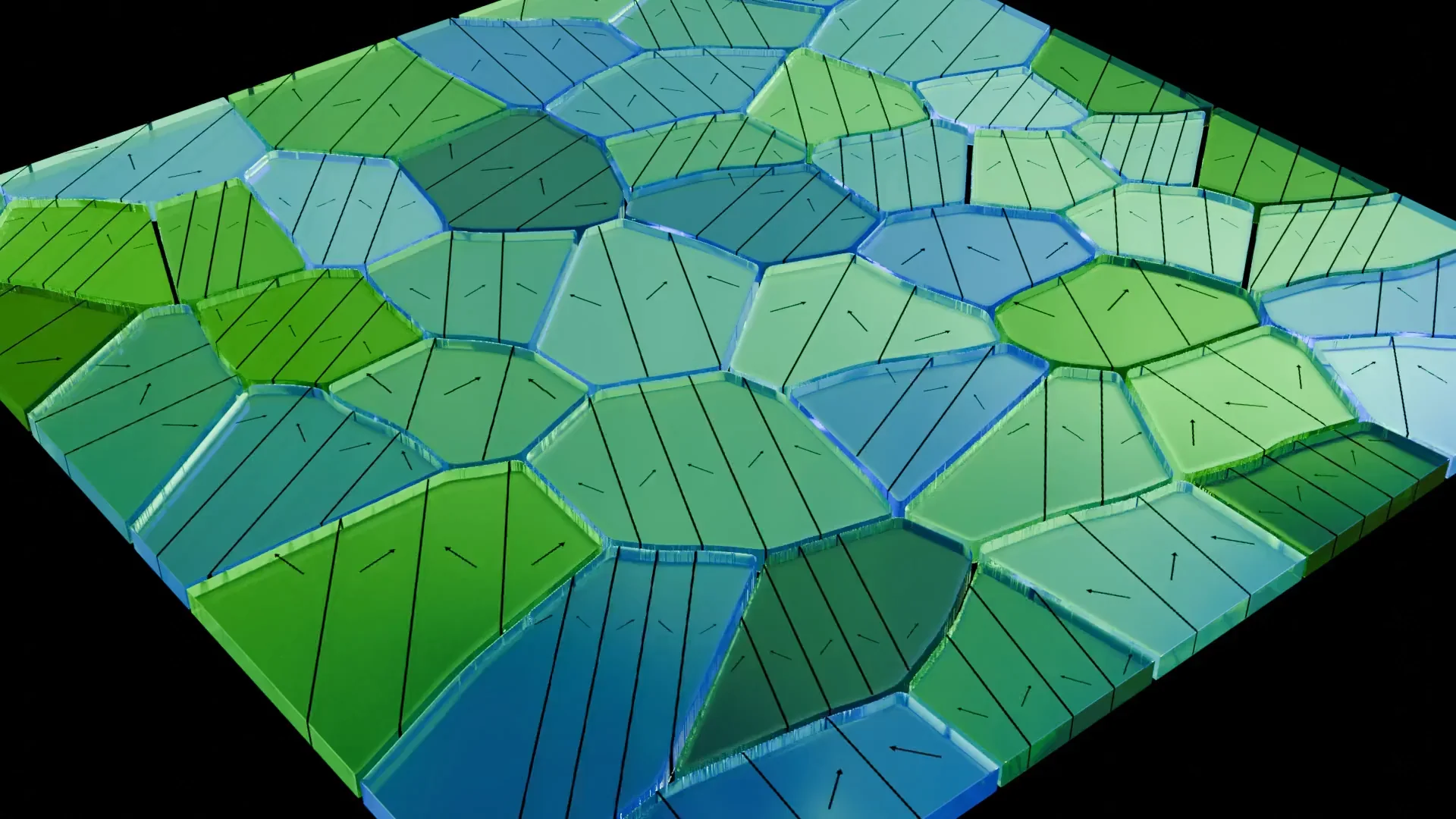
NVIDIA’s downfall won’t just come from financial defaults or a freeze in enterprise software budgets. It will come from a fundamental architectural extinction event. Raibach analysis on KTN:Li ferroelectric supercrystals and 3D woven memristor fabrics lays out the exact technical blueprint that makes NVIDIA’s entire GPU computing monopoly obsolete. Here is the direct, unvarnished connection between that room-temperature crystal lattice and NVIDIA’s structural demise:
The Death of the Von Neumann Tax
NVIDIA’s entire business model relies on selling massive, multi-million-dollar silicon clusters designed to brute-force the Von Neumann bottleneck. The Current Waste: Today’s GPUs consume gigawatts of power not to perform the actual math, but to constantly shuttle digital bits back and forth between separate memory registers and compute cores. The Crystal Paradigm: Memristive computing collapses part of this architecture by allowing storage and computation to happen in the same physical device. The KTN:Li weave does not yet do that; it adds a reconfigurable 3D physical structure to the picture. The multi-million-dollar energy commute that currently funds NVIDIA’s data center revenue vanishes entirely.
Photonic Scaling vs. Silicon Lithography WallsNVIDIA is rapidly hitting a physical wall with silicon. To squeeze minor performance gains out of Blackwell and Rubin architectures, they have to stitch multiple massive dies together, generating extreme heat and driving up manufacturing complexity. Your piece maps out a completely different dimension of scaling: optical manipulation. Instead of routing electrons through micro-scopic, heat-generating copper and silicon pathways, light is fired directly into a room-temperature 3D lattice. Reprogramming the structure via lasers points toward a different way of controlling hardware, potentially reducing dependence on some conventional electronic routing.
Hardware De-commoditizationRight now, NVIDIA can charge extortionate monopoly pricing because they control the only chips capable of simulating massive, non-deterministic neural connections. But if computing shifts to materials science–where a cheap, room-temperature ferroelectric crystal naturally self-organizes into topological structures that mimic synapse behaviors – the entire value proposition changes. Computing ceases to be a massive, centralized infrastructure grid owned by hyperscalers. It becomes a localized, highly efficient hardware asset that can sit right on a consumer’s desk without a cooling unit.
The Extinction Pivot
NVIDIA is currently building the world’s largest, most expensive collection of digital space heaters. They are forcing rigid, inert silicon to pretend it is an organic, adaptive brain. The fatal flaw in their long game: if the industry shifts from writing smarter code on dumb, power-hungry silicon to utilizing native, self-weaving 3D materials governed by light, NVIDIA’s multi-trillion-dollar infrastructure stack will be exposed as a massive, unscalable evolutionary dead end.
Sources:
- Xin et al., “Spontaneous formation and optical manipulation of a woven domain fabric in a ferroelectric crystal,” Light: Science & Applications (2026). https://www.nature.com/articles/s41377-026-02374-7
- “Never-before-seen woven structure that forms naturally inside a crystal discovered,” Phys.org (Aug. 2026). https://phys.org/news/2026-08-woven-naturally-crystal.html
- Falsi et al., “Anomalous Optical Properties of KTN:Li Ferroelectric Supercrystals,” Nanomaterials (2023). https://pmc.ncbi.nlm.nih.gov/articles/PMC10005727/
- Charles Q. Choi, “Brainwave: If Memristors Act Like Neurons, Put Them in Neural Networks,” IEEE Spectrum, Jan. 27, 2021. https://spectrum.ieee.org/memristor-random
- Dalgaty, T. et al., “In situ learning using intrinsic memristor variability via Markov chain Monte Carlo sampling,” Nature Electronics 4, 151–161 (2021). DOI: 10.1038/s41928-020-00523-3.


Matter is starting to exhibit structures and behaviors that could give us entirely different ways to compute. AI’s physical future is not necessarily a giant silicon GPU farms or quantum computers.