
“We believe that, in 2025, we may see the first AI agents ‘join the workforce’ and materially change the output of companies,” said Sam Altman.
Greg Nudelman – March 18, 2025
What are AI Agents?
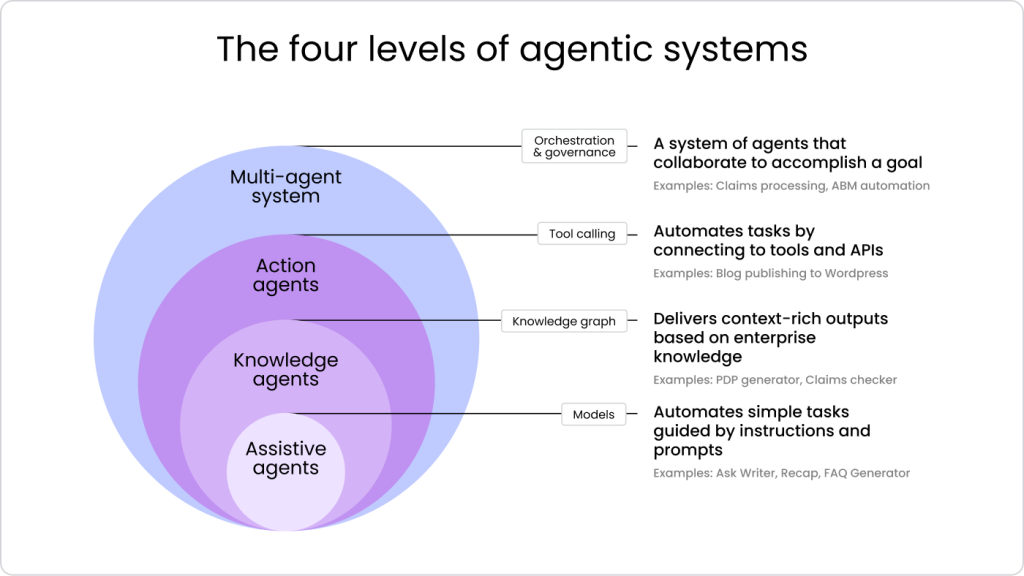
Imagine an ant colony. In a typical ant colony, you have different specialties of ants: workers, soldiers, drones, queens, etc. Every ant in a colony has a different job – they operate independently yet as part of a cohesive whole. You can “hire” an individual ant (agent) to do some simple semi-autonomous job for you, which in itself is pretty cool. However, try to imagine that you can hire the entire ant hill to do something much more complex or interesting: figure out what’s wrong with your system, book your trip, or …Do pretty much anything a human can do in front of a computer. Each ant on their own is not very smart – they are instead highly specialized to do a particular job. However, put together, different specialties of ants present a kind of “collective intelligence” that we associate with higher-order animals. The most significant difference between “AI,” as we’ve been using the term in the blog, and AI Agents is autonomy. You don’t need to give an AI Agent precise instructions or wait for synchronized output – the entire interaction with a set of AI Agents is much more fluid and flexible, much like an ant hill would approach solving a problem.
How do AI Agents Work?
There are many different ways that Agentic AI might work – it’s an extensive topic worthy of its own book (perhaps in a year or two.) In this article, we will use an example of troubleshooting a problem on a system as an example of a complex flow involving a supervisor agent (also called “Reasoning Agent”) and some Worker Agents. The flow starts when a human operator receives an alert about a problem. They launch an investigation, and a team of semi-autonomous AI Agents led by a supervisor agent help them find the root cause and make recommendations about how to fix the problem. Let’s break down the process of interacting with AI Agents in a step diagram:

Multi-stage Agentic AI Flow. Image Source: Greg Nudelman
A multi-stage agentic workflow pictured above has the following steps:
- A human operator issues a general request to a Supervisor AI Agent.
- Supervisor AI Agent then spins up and issues general requests to several specialized semi-autonomous Worker AI Agents that start investigating various parts of the system, looking for the root cause (Database).
- Worker Agents bring back findings to the Supervisor Agent that collates them as Suggestions for the human operator.
- Human operator Accepts or Rejects various Suggestions, which causes the Supervisor Agent to spin up additional Workers to investigate (Cloud).
- After some time going back and forth, the Supervisor Agent produces a Hypothesis about the Root Cause and delivers it to the human operator.
Just like in the case of contracting a typical human organization, a supervisor AI agent has a team of specialized AI agents at their disposal. The supervisor can route a message to any of the AI worker agents under its supervision who will do the task and communicate back to the supervisor. The supervisor may choose to assign the task to a specific agent and send additional instructions at a later time when more information becomes available. Finally, when the task is complete, the output is communicated back to the user. A human operator then has the option to give feedback or additional tasks to the Supervising AI Agent, in which case the entire process begins again.
The human does not need to worry about any of the internal stuff – all that is handled in a semi-autonomous manner by the supervisor. All the human does is state a general request, then review and react to the output of this agentic “organization.” This is exactly how you would communicate with an ant colony if you could do such a thing: you would assign the job to the queen and have her manage all of the workers, soldiers, drones, and the like. And much like in the ant colony, the individual specialized agent does not need to be particularly smart or to communicate with the human operator directly – they need only to be able to semi-autonomously solve the specialized task they are designed to perform and be able to pass precise output back to the supervisor agent, and nothing more. It is the job of the supervisor agent to do all of the reasoning and communication. This AI model is more efficient, cheaper, and highly practical for many tasks.