Prompt Portal for Enterprise AI Lifecycle Management – Focus on Adoption and Collaboration

Client: Southern California Edison (SCE)
Timeline: November 2025 – February 2026 (contract with Logic2020.com)
Role: Lead Product Designer – UX strategy, React/Python frontend development, enterprise AI platform
Team: Business Systems Analyst, Product Owner, AI Architects, Subject Matter Experts
Tools: Figma, Maze, VS Code, Copilot

Project Summary

At Southern California Edison, I led UX design for an enterprise AI prompt portal during a critical three-month discovery phase. The challenge: enable 15,000+ employees with vastly different AI literacy levels to adopt prompt engineering best practices in a highly regulated utility environment where safety and compliance are paramount.

Stakeholder interviews revealed that AI adoption was stalled by lack of standardization, redundant experimentation across departments, and missing compliance audit trails. The solution: a unified adaptive flow that guided all users from novices to advanced practitioners through sophisticated AI capabilities while maintaining governance and auditability.

https://github.com/Raibach


Onboarding New Users

A key innovation was the “Progressive Trust” framework – an adaptive onboarding flow that met users at their skill level rather than forcing everyone through the same experience. The system guided novices through basics while allowing experts to skip ahead, ensuring both compliance and efficiency.

Console (central prompt management)


Color experimentation We anticipated a variety of card types and branding – all the same size with variations in color, similar styling to help align visually. These will evolve with the application and provide a personalized touch for better adoption.

Key Challenges

Original Problem: AI Adoption Barriers in Regulated Environment

SCE employees were already using AI tools like Microsoft Copilot and ChatGPT for daily work, but without any centralized platform for management, governance, or knowledge sharing. This created
critical obstacles:

• Varied AI literacy: Users ranged from employees unfamiliar with prompting to engineers requiring sophisticated agentic workflows

• Lack of standardization: No consistent approach to prompt quality, safety protocols, or compliance documentation across 50+ departments

• Redundant experimentation: Teams duplicating AI efforts without knowledge sharing, estimated 60%+ wasted effort

• Missing audit trails: No governance framework for tracking AI usage in safety-critical utility operations

• Regulatory constraints: Utility operations require transparent, auditable AI decision-making, but existing tools (Copilot, ChatGPT) provide no enterprise oversight

THE INSIGHT
The problem wasn’t that employees weren’t using AI. It was that they were using it in silos, without governance, standardization, or institutional learning. SCE needed a centralized platform that could harness existing AI adoption while adding the governance layer required for regulated operations.

User-Centered Solution: Unified Adaptive Flow

The breakthrough was designing a unified platform that could harness existing AI adoption while adding the governance layer that consumer tools like Copilot lacked. Rather than creating separate interfaces for beginners and experts, I implemented progressive disclosure that revealed complexity based on user actions and confidence. Each skill ranking has different levels of use within the same system design.

Evaluated user context (role, department, use case)

Provided appropriate scaffolding (templates for novices, advanced parameters for experts)

Maintained governance (tagging, review workflows, compliance documentation)

Enabled discovery (searchable prompt library with performance tracking)

This approach accelerated adoption by meeting users where they were, rather than forcing them to navigate complexity they didn’t need.

Prompt Composer

Initial Wireframe Concept:

Early design exploration showing the solution is not only collaborative by design but also reflects real-world AI teamwork patterns where contributions from multiple experts (engineers, domain leads, reviewers) are combined into certified, reusable response formats. This approach:

Encourages shared ownership and continuous improvement.

Aligns with platforms like Microsoft Teams Copilot, PromptDrive.ai, and CrewAI, where agents and humans co-build, test, and refine workflows.

Uses peer review, evals, and versioning to ensure quality before release.


A/B testing a prompt wireframe:

When A/B testing a prompt’s performance by comparing outputs from the same model, the following four settings (parameters) are the industry standard to display. These directly control the model’s randomness, diversity, and length, which are the primary variables affecting output quality.

Top-Level Prompt Performance Metrics

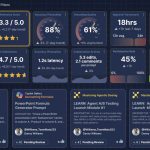
These metrics are displayed on a prompt’s “parameters tile” or summary row. In a prompt management systems, top-level trace metrics provide an at-a-glance health check for each prompt before a user dives into granular execution steps. For 2026, standard dashboard entries focus on balancing cost, speed and reliability.

Solution Overview

The redesign centered on democratizing AI while maintaining enterprise control critical in regulated utilities where autonomous decisions must be transparent and auditable.

Through discovery workshops with SMEs, engineers, and cross-functional stakeholders, I identified four core user journeys:

Discover: Search and filter prompts by role, department, use case, and performance metrics

Submit: Create new prompts with guided templates or advanced agentic workflows

Review: Governance workflow for validating prompts against safety protocols and compliance requirements

Track: Performance monitoring and continuous improvement based on usage analytics.


Copilot becomes context-aware: it tracks what the user clicks, loads the right diagnostic lens, and offers one-click fixes tied to the actual failure mode. When the user is in the relevance list view, they are seeing a ranked list of low-scoring prompts (e.g., relevance < 3.5), sorted worst to best.

Progressive Disclosure Strategy

The interface adapts based on user behavior:

Novice path: Pre-built templates, contextual help, guardrails preventing unsafe configurations

Intermediate path: Template customization, parameter tuning, basic agentic features

Advanced path: Full control over prompt engineering, multi-agent orchestration, custom tool integration

This eliminated the need for separate “beginner” and “expert” modes while maintaining safety and governance.


Adaptive Design for Varied Skill Levels:
Single interface serving novices and experts simultaneously through progressive disclosure, accelerating adoption without compromising capability.

Discovery-Driven Governance: Research revealed that centralization wasn’t about control, it was about trust. Audit trails, performance tracking, and transparent review workflows built confidence in AI outputs.

Scalable Foundation: Personas, journey maps, and information architecture continue to inform SCE’s enterprise AI strategy beyond the initial discovery phase.

Research

The research phase focused on understanding adoption barriers across a diverse user base and designing for trust in a high-stakes environment. I partnered with Business Systems Analysts, Product Owners, and AI architects to conduct:

• Stakeholder interviews (15+ sessions across departments)
• User workflow observations (field operators, engineers, managers)
• Competitive analysis (enterprise AI platforms)
• Regulatory constraint mapping (utility compliance requirements)

Key Findings

Adoption barrier wasn’t technical, it was trust. Users needed confidence that prompts would produce consistent, reliable results; AI outputs could be validated against safety protocols; Usage would be tracked for compliance and continuous improvement. The system will not expose them to regulatory risk.

Centralization was essential for governance, not control. By creating a single source of truth for prompts, SCE achieved:

  • Reduced redundant experimentation (estimated 60%+ efficiency gain)
  • Established quality standards and review workflows
  • Built institutional knowledge rather than siloed expertise
  • Enabled rapid iteration based on performance data

Progressive disclosure enabled adoption. Users didn’t need to understand agentic AI to benefit from it, the interface could guide them through increasing complexity as confidence grew.

Outcomes

These findings shaped the core design principle: meet users where they are, guide them where they need to go, maintain governance throughout. This project demonstrated that successful AI adoption in regulated environments isn’t about technology. It’s about trust, governance, and meeting users where they are.

The “Progressive Trust” framework proved that a single interface could serve both novices and experts without compromising safety or capability. By centering the design on user confidence rather than technical complexity, we created a foundation for enterprise AI adoption that balances innovation with compliance.

Design Innovation:

  • Created “Progressive Trust” framework: single adaptive
    interface serving novices and experts.
  • Pioneered governance-first AI adoption model balancing
    innovation with compliance seamlessly.
  • Established scalable information architecture supporting
    future AI tools and expansion.

View Prototype:
https://www.figma.com/proto/20UPR2KQMsbAxlo5NJb1se/Wireframes–v.4b–SCE-Enterprise-AI-Prompt-Platform

Oversight & Governance with Meaningful Metrics

I spent the first month in discovery identifying the most meaningful AI prompt evaluation metrics and design layouts for enterprise oversight and prompt management. With dozens of potential data points to track, the key question was: which metrics provide actionable insights at different organizational levels? For administrators overseeing collaborative prompt management, three metric categories emerged as critical:

Quality & Performance
• Accuracy rates and consistency scores
• Response latency and token efficiency
• User satisfaction ratings

Adoption & Usage
• Active users and prompt submissions
• Collaboration activity (comments, iterations)
• Department-wide engagement

Governance & Compliance
• Approval workflows and review times
• Compliance adherence rates
• Audit trail completenessEnterprises often invest millions in AI tools expecting significant
ROI. However, returns depend entirely on adoption and effective
usage.Without meaningful metrics, organizations can’t:
• Identify what’s working (and what isn’t)
• Justify continued investment
• Optimize for better outcomes
• Ensure compliance and safetyThe dashboard below provides real-time visibility into all three
metric categories, enabling data-driven decisions at every level.


Leave a Comment

Comments

No comments yet. Why don’t you start the discussion?

Leave a Reply

Your email address will not be published. Required fields are marked *