Client: Southern California Edison (SCE)
Timeline: November 2025 – February 2026 (contract with Logic2020.com)
Role: Lead Product Designer – UX strategy, React/Python frontend development, enterprise AI platform
Team: Business Systems Analyst, Product Owner, AI Architects, Subject Matter Experts
Tools: Figma, Maze, VS Code, Copilot
Onboarding New Users
A key innovation was the “Progressive Trust” framework – an adaptive onboarding flow that met users at their skill level rather than forcing everyone through the same experience. The system guided novices through basics while allowing experts to skip ahead, ensuring both compliance and efficiency.
 Console (central prompt management)

Color experimentation We anticipated a variety of card types and branding – all the same size with variations in color, similar styling to help align visually. These will evolve with the application and provide a personalized touch for better adoption.
Key Challenges
Original Problem: AI Adoption Barriers in Regulated Environment
SCE employees were already using AI tools like Microsoft Copilot and ChatGPT for daily work, but without any centralized platform for management, governance, or knowledge sharing. This created
critical obstacles:
• Varied AI literacy: Users ranged from employees unfamiliar with prompting to engineers requiring sophisticated agentic workflows
• Lack of standardization: No consistent approach to prompt quality, safety protocols, or compliance documentation across 50+ departments
• Redundant experimentation: Teams duplicating AI efforts without knowledge sharing, estimated 60%+ wasted effort
• Missing audit trails: No governance framework for tracking AI usage in safety-critical utility operations
• Regulatory constraints: Utility operations require transparent, auditable AI decision-making, but existing tools (Copilot, ChatGPT) provide no enterprise oversight
THE INSIGHT
The problem wasn’t that employees weren’t using AI. It was that they were using it in silos, without governance, standardization, or institutional learning. SCE needed a centralized platform that could harness existing AI adoption while adding the governance layer required for regulated operations.
User-Centered Solution: Unified Adaptive Flow
The breakthrough was designing a unified platform that could harness existing AI adoption while adding the governance layer that consumer tools like Copilot lacked. Rather than creating separate interfaces for beginners and experts, I implemented progressive disclosure that revealed complexity based on user actions and confidence. Each skill ranking has different levels of use within the same system design.
Evaluated user context (role, department, use case)
Provided appropriate scaffolding (templates for novices, advanced parameters for experts)
Maintained governance (tagging, review workflows, compliance documentation)
Enabled discovery (searchable prompt library with performance tracking)
This approach accelerated adoption by meeting users where they were, rather than forcing them to navigate complexity they didn’t need.
Prompt Composer


Solution Overview


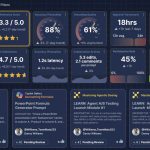
Oversight & Governance with Meaningful Metrics

|
I spent the first month in discovery identifying the most meaningful AI prompt evaluation metrics and design layouts for enterprise oversight and prompt management. With dozens of potential data points to track, the key question was: which metrics provide actionable insights at different organizational levels? For administrators overseeing collaborative prompt management, three metric categories emerged as critical: Quality & Performance Adoption & Usage |
Governance & Compliance • Approval workflows and review times • Compliance adherence rates • Audit trail completenessEnterprises often invest millions in AI tools expecting significant ROI. However, returns depend entirely on adoption and effective usage.Without meaningful metrics, organizations can’t: • Identify what’s working (and what isn’t) • Justify continued investment • Optimize for better outcomes • Ensure compliance and safetyThe dashboard below provides real-time visibility into all three metric categories, enabling data-driven decisions at every level. |